BAYONA
Bayona, born in Colombia, considers himself a son of the Andes, “their winds and peaks, their songs and whispers, have carried me beyond borders.” He follows the ancient paths of South American Indigenous cultures, moving through sacred Andean territories guided by his camera, sketchbooks, architectural notes, and an understanding of each land’s cosmology. His work unveils the guardian presences of the mountains—the Apus—while articulating a urgent message: the landscape is alive and must be honored.
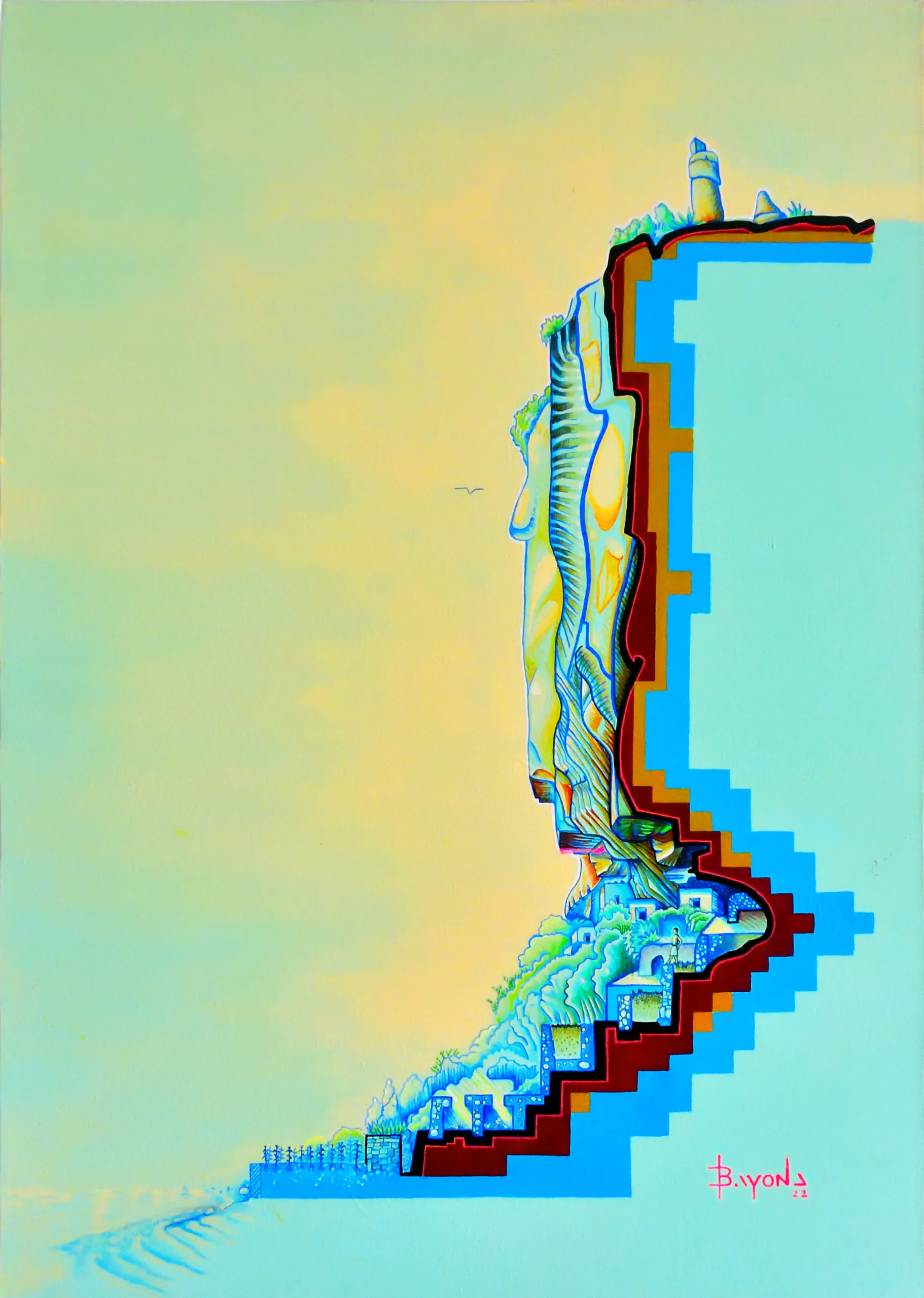
Through what he defines as totemic painting or wak’anist painting, Bayona integrates compositional structures and patterns derived from pre-Hispanic cosmovision and sacred geometries. Bayona’s recent artwork, across both analog and digital media, is marked by chromatic energy and layered symbolism. Fluorescent colors render kamaqen, the vital force emanating from places of power such as mountain peaks, lagoons, and caves. Themes include the genesis of form, the balance of complementary opposites, the tripartite Andean conception of space and time, the four cardinal directions, totemic animals, and an animistic vision in which rocks and vegetation are endowed with agency. Through these elements, Bayona constructs a sacred landscape that invites the viewer into a connection with ancestral memory, fostering collective awareness around the care and preservation of Allpa Mama (Mother Earth).
The Chakana is an ancient pan-Andean pattern central to Bayona’s work. He understands it as a geometric and energetic code that transcends the boundaries of the Andean world. It can be found in the art and architecture of Anahuac, the textiles of North American peoples, such as the Sioux; upon carved rocks in Saudi Arabia; and even on the Islamic world’s madrasas. The Chakana represents a multitude of concepts: the three Andean worlds (upper, middle, and lower), the four cardinal directions, and serves as a geometric guide to mark key dates. It is also incorporated in architectural design structures, like stepped agricultural terraces and water systems. The colors in Bayona’s work (cyan, ochre, brown, and fuchsia) allude to the four Ayllus, an ancient Andean social structure that links its members through kinship. Through his pieces, one can experience spiritual transcendence through time and culture.

SELECTED WORKS PREVIEW
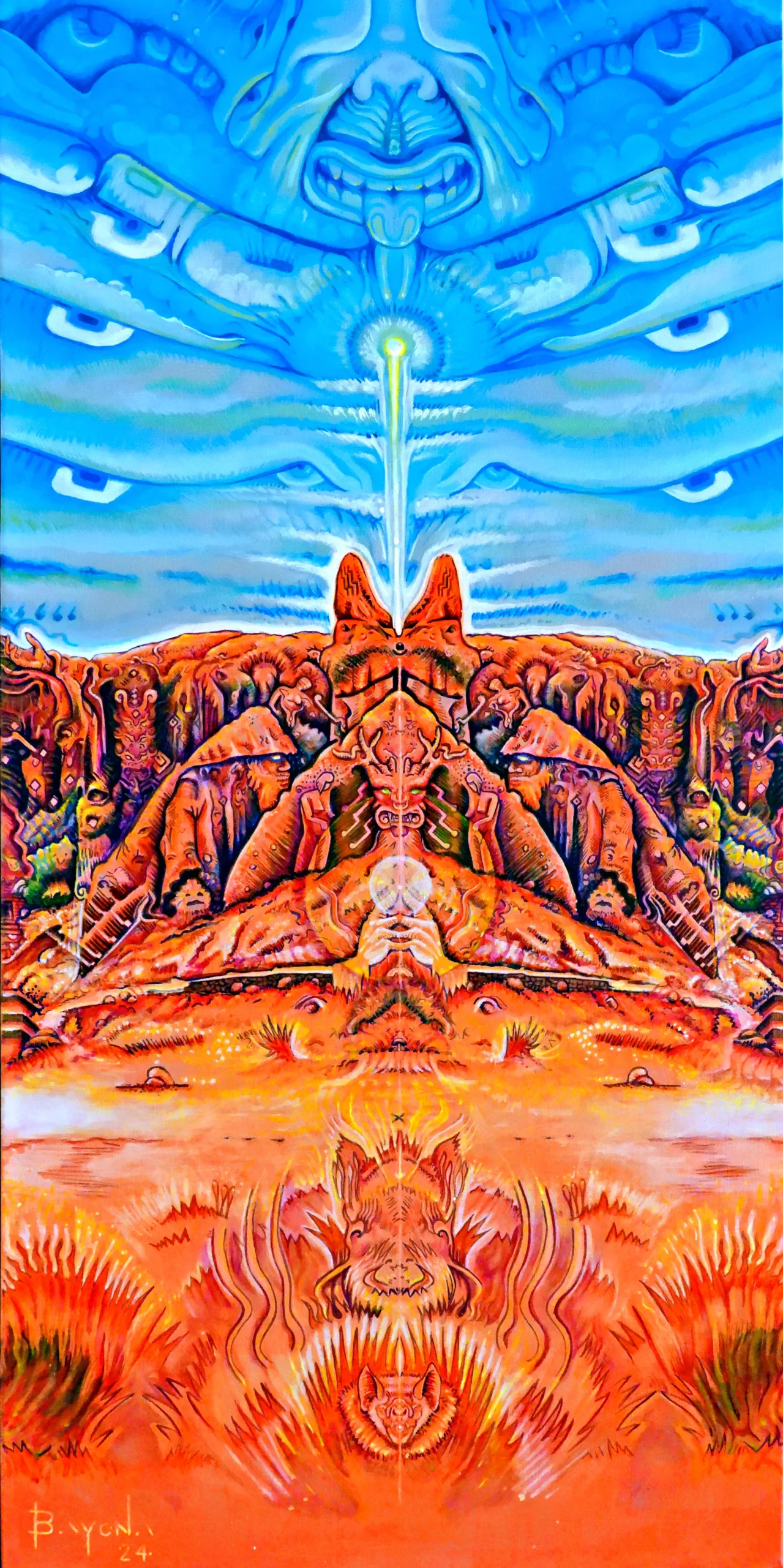
Apu Kunpi Maiu, Bayona